Wednesday, April 24, 2013

Why France?

I have written previously about the reason that we are moving to France. Quite simply, we believe that the Lord is calling us there and as His followers, we will go where he leads us. Our time in France last summer began to open our eyes to some of the reasons why the Lord would have us invest our lives there. The greatest reason is the incredible need for people to hear the gospel.

While the Cathedral dominates the landscape of Strasbourg, the spiritual reality is much different. Jesus does not dominate the lives of the people. The country is nominally Roman Catholic, but the Catholic church is continuing to lose influence in the culture and people are adopting an increasingly secular mindset. While 61% identify themselves as Christian, over thirty percent declare themselves to be non-religious.

If we look deeper and ask how many believe that salvation is found through Christ alone, that personal faith and regeneration by the Spirit is essential, that the Bible is the inspired word of God, and that commitment to sharing the gospel is important (Operation World's definition of evangelical) the number drops to 1%. There are 4-5 times that number of Muslims in France. There is a higher percentage of evangelicals in Egypt than in France! The sad reality is that most of the people living in France have never truly encountered the Gospel. According to many sources, France is one of the least evangelized countries in the world.

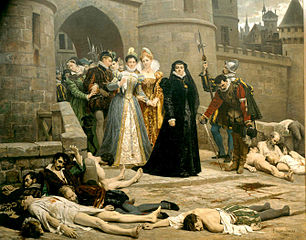
http://en.wikipedia.org/wiki/French_Wars_of_Religion
One Morning at the Gates of the Louvre
I think that this may be rooted in the history of France. As a country situated between Rome and Germany, France was a key battleground between the Protestants and Catholics. For much of European history, the church and state were intertwined. Emperors courted the church and church leaders courted the emperors. In for centuries France was entangled in series of religious wars that were fed by the egos of both the political and ecclesiastical leadership. Finally in the French Revolution the French people said, "Enough!" and cast down both the political and religious systems creating the first "modern secular state." Democracy was tied to freedom from the authority of the (Roman Catholic) church. Two hundred years later the result is a country that feels that Christianity is a mere relic of an unsuccessful past. At the same time, the occult has increasingly stepped into the spiritual vacuum. It is estimated that ten million French people see occult practitioners spending billions of dollars in the process.
 
As we move to France in a few months, we are seeking to minister to the English-speaking community in Strasbourg, but our hearts yearn to see the French people discover the beauty of Christ and his amazing love for them. The obstacles are many, but through prayer and obedience to the Holy Spirit we believe that many will discover the love of the Savior.

Operation World provides insights into how to pray for France. Here are some highlights:
  • Pray that the legacy of religious/political violence would change from skepticism of Christianity to a renewed interest in the gospel.
  • Pray against the widespread involvement in the occult. There are more people earning a living in occult practices than there are registered doctors in France!
  • Pray about the declining influence of the Catholic church. In 2005 only 150 men were training for the priesthood. Pray that the Holy Spirit would breathe life into the church.
  • Pray for unity among evangelical believers. There has been remarkable progress in this area over the last decade or so, but more needs to be accomplished. 
  • Islam is now the second largest religion in France. Pray for effective outreach to the Muslim community as well as peaceful assimilation into French society.
  • Pray for youth ministry in France. The youth are a nation's future, and many young people are unemployed and France has the highest teen suicide rate in the world.


Monday, April 1, 2013

The Bells of Saint Maurice

St. Maurice Church
One of the memories that we cherish of our stay in Strasbourg last year is the church across the street from our apartment: Saint Maurice. Its tower was a beacon when we were lost, its benches served as delightful reading places, and its bells were a constant reminder of God's presence. We are looking forward to returning to the shadow of that church building, just as when we were in France we found ourselves longing for the lake and the call of the loons.

For some reason, I got to wondering the other day about who Saint Maurice was. I had never heard of him before and so I set off on a journey of research to learn about him. What a story I found! While it is somewhat shrouded in the mists of history, the basic facts are fairly clear.

Back to the Third Century


Maurice was solider from Thebes, Egypt who commanded a legion for the Roman Emperor, Maximian. It was a time when Christians were regarded with a high degree of skepticism by Rome, yet the legion of 6,600 which Maurice led had all committed their lives to Christ.The power of Rome was waning, and in the late third century the Emperor was faced with a number revolts of peasantry, particularly on the frontiers of the empire.

Near ancient Agaunum in the Swiss Alps
To quell one such insurrection, Emperor Maximian ordered the Theban legion, led by Maurice, to clear the Great St. Bernard Pass (yes, those St. Bernards) of insurrectionists. Upon arriving at the Roman outpost of Agaunum, high in the Alps, they were ordered to attack the peasants living nearby. When they discovered that the peasants were Christians, the entire legion refused to assault them. Then they were ordered to sacrifice to the Roman gods and the legion refused again.

Emperor Maximian was incensed and after repeatedly having his orders ignored he commanded that the legion be decimated. This was a Roman practice used to punish belligerent or cowardly soldiers. One tenth (deci = 10) of the soldiers would be executed. The decimation order was followed and 660 of the 6600 soldiers were killed, yet the legion refused to offer the pagan sacrifices or attack their fellow Christians. An enraged Maximian issued another decimation order and another tenth of the legion was executed.

Maximian
Upon learning the that legion still refused to follow his orders to make pagan sacrifices or assault the peasant believers, Maximian warned the soldiers that they would all be executed if they did not change their minds. Maurice and his fellow soldiers sent the following reply:
"Emperor, we are your soldiers but also the soldiers of the true God. We owe you military service and obedience, but we cannot renounce Him who is our Creator and Master, and also yours even though you reject Him. In all things which are not against His law, we most willingly obey you, as we have done hitherto. We readily oppose your enemies whoever they are, but we cannot stain our hands with the blood of innocent people (Christians). We have taken an oath to God before we took one to you, you cannot place any confidence in our second oath if we violate the other (the first). You commanded us to execute Christians, behold we are such. We confess God the Father the creator of all things and His Son Jesus Christ, God. We have seen our comrades slain with the sword, we do not weep for them but rather rejoice at their honour. Neither this, nor any other provocation have tempted us to revolt. Behold, we have arms in our hands, but we do not resist, because we would rather die innocent than live by any sin.'' 
St. Maurice
When the emperor read this letter he realized that he would be unable to force these soldiers to take up arms against fellow Christians. He then had the the entire legion executed. In addition, he issued orders that any who belonged to this legion who were not present in the pass that day be hunted down and killed.

Maurice's refusal to obey the Emperor's orders to violate his faith caused his life to be fondly remembered by fellow Christian soldiers. He is highly esteemed by the Coptic (Egyptian) Church and eventually became the patron saint of infantrymen in the Roman Catholic Church. So it is a fitting name for a church originally built by the Germans for the use of Catholic military personnel stationed in Strasbourg.

But there is more.


The site of the martyrdom of Maurice and his legion became a monastery. In 522 the abbot of the monastery instituted the recently developed pattern of laus perennis, whereby choirs of monks rotated so that they offered non-stop 24/7 prayer and worship to God. This non-stop intercession continued at the location for almost four hundred years! It introduced the idea of non-stop prayer and worship to the West and had a dramatic impact on monasteries all over France and Switzerland.

Running down the story of St. Maurice was not only fascinating, it provided a link between the past and the present as we see 24/7 prayer movements spreading across the world. For me the bells of St. Maurice will now be a call to pray without ceasing. They will also remind me of a church in the northwoods of Minnesota that discovered the power of 24/7 prayer.


Wednesday, March 27, 2013

What I Will Miss (3) - Late Winter

The view out our window.
Winter is the way of life in the north country.  Even in the summer a northern breeze seems to carry a bit of the arctic with it. On the warmest of summer days it seems like a person could climb a white pine and see winter on the edge of the northern horizon. It is March 27th, and the snow is still over two feet deep in the yard. A friend went snow-shoeing with her daughter today.

Still, the season is ripe for signs. Just last week I smelled a skunk. Their odor, normally unpleasant, is one of the most welcome scents this time of year. Despite temperatures that are well below freezing, the smell means that the skunks are coming out of hibernation and beginning to become active.  They are looking for mates. In May they will give birth to their young. Skunks are a nuisance most of the year, but when a whiff of their smell is carried on the winter breeze, it is a sure sign that beneath all of the cold, winter is weakening ever so slightly. 

This morning I thought I heard geese flying overhead. A check of a nearby river proved I was right: there was a patch of open water with 8 Canadian geese swimming in it. The sight of geese would not be noteworthy in June, but I haven't seen the geese for almost half a year. I watched them for a while as I pondered the fact that I had survived another winter.

Last week my attention was drawn to another faint sound I had not heard for months: running water. It was the smallest of trickles, but my heart leaped at its sound. The sun, so low in January's sky that it carries no heat, had finally risen enough to begin the process of melting the snow. The south facing drifts are the first to feel its effects. Over the coming weeks there will probably be another snowstorm or two, but things are different now. The melting of the snow has begun. It will take weeks to finish. The lakes will open up around the last week of April and then in May the hills will begin to turn the faintest of greens.

The magic of late winter in the north is not something that attracts tourists, yet it is more wonderful than going to the beach for the sun and a swim. To know what the trickle of water means you have to go through a half-year of enduring the bitterness of winter. You have to have changed a tire when it is -30, driven countless miles on snow-covered roads, and despaired of ever truly being warm again in order to understand the smell of the skunk, the honking of geese, or the simple trickling of water.

That is why I will miss it...because the end of the northern Minnesota winter is not something that you can ever visit. If in the future I return to the north at the end of March, I will only be able to remember what those signs once meant. I won't be able to truly experience them again. They will be a part of the wonder of my northern Minnesota past that I will never forget and always cherish.

If you don't think this is funny, you've never spent a month below 0!

Sunday, March 17, 2013

An Introduction to Strasbourg

I am an American. While this brings with it many benefits, it also carries with it a number of weaknesses. For example, the fact that I can drive for a couple of thousand miles from my home without needing to speak another language means that I have never learned to speak another language. Our sheer size and location between two oceans and two friendly neighbors means that world news is generally relegated to page three or four of the newspaper. Most Americans would have a hard time naming the heads of a half-dozen foreign countries. While my interest in missions has broadened my horizons, the reality is that I had never heard of Strasbourg until someone asked if I would be interested in taking a sabbatical there last year. Like many people, when I heard the name I assumed that the city was located in Germany. And I would have been almost right. It has been in Germany. Several times.

Confused? I was. Here's the story.

First Roman...

Strasbourg started out as an outpost of the Roman Empire in 12 BC. The Romans called it Argentoratum. As a base on the frontier of the Roman Empire, it suffered a variety of battles and was finally overrun by the "barbarians" in the fourth century.

...Then German...

The Cathedral in Strasbourg
By the 10th century, the town had become known as Strasbourg and had become a part of the Germanic Roman Empire. While Christian worship had been taking place in the city for centuries, work on the city's crown jewel, the Cathedral, began in earnest in the 12th century. When completed in 1439, it became the tallest building in the world. Shortly thereafter, Johannes Gutenberg invented Europe's first movable type printing press in the city and the first  modern newspaper was published in Strasbourg in 1605.

The 16th century saw Strasbourg as influential center of the Protestant Reformation. Martin Bucer agreed with the teachings of Martin Luther and the city's printing industry helped the intellectual movement of the reformation flourish. Worship in the Cathedral became Protestant. For several years the great Swiss theologian John Calvin took refuge in the city.

...Then French...

The Cathedral as a
"Temple of Reason"
during the French
Revolution
While Strasbourg was neutral during the Thirty Years War, it was suddenly annexed by the French in 1681. The French at the time were not tolerant of Protestants, but Strasbourg and the region of Alsace enjoyed a special status. The Cathedral was returned to the Catholics and Catholicism was promoted, but Protestants enjoyed relative freedom in the area.

The French Revolution brought many changes to Strasbourg. Many churches were destroyed and the Cathedral lost many of its statues. In 1794 there was serious talk of tearing the Cathedral's spire down because zealots thought it represented ideals contrary to Revolution. Creative citizens quickly built a giant Phrygian cap (a symbol of the Revolution) and put it on the tower, thus saving this incredible building.

Saint Maurice Church
 near our apartment

...Then German...

The middle of the 19th century brought the Franco-Prussian war to the area and the siege of Strasbourg in 1870 destroyed many of the city's finest collections in a bombardment. Ironically, destruction came as a result of a poorly done French map that had been captured by Germans. The map erroneously labeled the city library as the city hall. At the end of the war, Strasbourg became German once again. A ring of fortifications was built around the city and are now popular destinations. Two beautiful churches were built to serve the German troops. The Catholic church, Saint Maurice, is across the street from our apartment and its bells are a constant reminder of the presence of God.

President Wilson

...Then French...

At the end of World War I the Treaty of Versailles returned the region to the French. One of President Wilson's Fourteen Points read, "All French territory should be freed and the invaded portions restored, and the wrong done to France by Prussia  in 1871 in the matter of Alsace-Lorraine, which has unsettled the peace of the world for nearly fifty years, should be righted, in order that peace may once more be made secure in the interest of all."

...Then German...

That security was short-lived. At the start of WWII, Hitler "liberated" Strasbourg and the Alsace region from the French. Many of young men who lived in Alsace were forced to serve in the German army at the Russian front. Robert Heinrich Wagner was installed to rule Alsace. His nickname "The Butcher of Alsace" sheds light on the conditions under the Nazis. Thousands died at his direction.

...Now French and a Symbol of Unity

Allied bombing damaged much of the city before French troops entered it once again in 1944 and it has remained French to this day.

The Alsatian city of Strasbourg, with its long history of French and German influence has become a symbol of unity in Europe. In 1949 it became the home of the Council of Europe with its Court of Human Rights. In 1951 the European Parliament began meeting in Strasbourg and named the city its official seat in 1991. 

It is also the home of Trinity International Church, a church that welcomes people from all nations to join together in worshiping and serving the Lord Jesus Christ.

So there you have a brief introduction to the history of the this wonderful town, where every person has a story and every corner has a cafe in which to tell it.

Thursday, March 7, 2013

But They Speak French!

Inspector Clouseau.
It was a simple decision that I would not regret for almost forty years.

Should I take French or Spanish? It is a weighty decision for a seventh grader. The responsible thing to do was to take Spanish because there was a growing Hispanic population in our area. But that is not why I chose Spanish. I made the decision in the typical seventh grader way: Spanish was more fun. The French teacher was strict and constantly drilled grammar and vocabulary. Students came out of her classes with glazed eyes and French accents. They whispered in French to each other in the hallways. The Spanish teacher, on the other hand, had weekly taco parties. By the end of the year students had mastered the words "enchilada" and "burrito". All the cute girls took Spanish because the teacher was also the cheerleading coach. To top it off, my best friend Noel was taking Spanish. Not only was Noel a cheerleader, she was hilarious. Which did I want to do: learn a language or hang out with cheerleaders, be silly, and eat tacos? The decision was ridiculously easy.

How could I know that I would one day move to France? Oh what mighty consequences there are in decisions made by twelve year-old boys! Had I chosen differently I would know how to order a meal, count change, and read the street signs in France. But now I must learn a new language after speaking nothing but English for almost half a century. Woe is me!


The Voyageurs
You would think that living in northern Minnesota would be an advantage in learning French. This area was once the domain of French voyageurs. They paddled the waterways trading for furs with the Natives. French songs echoed across the lakes as they made their way at summer's end to the Grand Portage and Lake Superior. The voyageurs belong to yesteryear. No one speaks French here anymore. There are no French classes within sixty miles of here.

I am on my own.

"Bring him back to me you will."
I've been told that the most common 1000 words will give you about 70% of the vocabulary you need to read a typical newspaper. So I found a wonderful flashcard program called Anki  and am using it to drill vocabulary.  I love French words like "docteur". It means doctor! I hate French words like "blesser". It means to hurt or injure! I have been working through some Basic French workbooks. Who knew that every French noun had a gender? Apparently back at the Tower of Babel they flipped a coin to choose the gender of every word. And the French sentence structure? It sounds like Yoda-speak to me.

He might be a relative...
The hardest part is pronunciation. I have been told that all I need to do to pronounce French properly is use my best Inspector Clouseau impersonation. I try. I really do try. For some reason the French don't pronounce the last part of most written words, so I hack off the ending and give it my best Clouseau. My wife, who was wise enough to take French in high school, furrows her brow and says, "What did you say?" So I try again. The harder I try the worse it gets. Apparently my Clouseau accent sounds more like a drunk Norwegian than a Frenchman! If only I could take a class! Jesus, HELP ME!

Enter God.

Two weeks ago my wife Janet noticed a young woman sitting by herself during our church service. The young woman was new to the area and was checking out our church. When Janet mentioned that we would be moving to France the woman smiled and said, "That's interesting, my husband is fluent in French! In fact, I am sure he would love to teach you!" And so he started private classes with us. As we spend time together my tongue is starting to make the right sounds. I am beginning to understand French. Along the way we are becoming friends.

I am learning to trust God. He has asked me to move to France and when I despair of learning a new language He proves he cares about me. He provides in unexpected ways. Following Him is not always easy. Nor is it always fun. Sometimes it is endless drills rather than taco parties. But it the end, following Him is absolutely the best way to live. He surprises us again and again with His faithful provision and care.

The apostle Paul wrote of times that he enjoyed seasons of abundance, but he also wrote of seasons of great hardship. There were times of joy and times of discouragement. Through it all God was teaching Him to be truly satisfied in Him. That is the secret of contentment that he wrote about in Philippians 4:12-13. As Paul reflected on what he had been through he wrote, "I can do all things through Him who gives me strength." While Paul was never faced with my situation, I am convinced that "learning French" is included in the words "all things."


Tuesday, February 26, 2013

The Potential of the Local Church

"How do you see potential in a church located in a small town with declining population?"

The question hung in the air awaiting my response. I faced a room full of bible college students who were thinking about a future in ministry. A friend was teaching the class and had brought me in to give the students the  perspective of a small town pastor. Like the many of the students, I had been raised in the suburbs. I moved two years previously to Nashwauk, a small town on the Iron Range of Minnesota that had seen decades of decline. The sign on the edge of town said its population was 983, but I suspected that was only true on homecoming weekend.


In my first months at the church I learned that small struggling towns are very different than the fast growing suburbs. The pace of life and attitudes of people were different. Not only that, but it seemed like the all of the materials generated by the Christian resource companies were geared toward the suburbanite. They were expensive and they did not apply to our situation. For example, I had recently looked at an evangelism curriculum that spent half of its time talking about creative ways to meet your neighbors. In my town everyone already knows everyone! The reality is that in the Christian publishing industry resources are developed for churches with the money to buy them. 

Nashwauk's Central Avenue.
As I pondered my response to the student's question I recalled an article I had received from our district office. It was meant to encourage pastors. It was written by a church health guru and talked about the environment that would support a thriving church. It mentioned things like an "expanding population base", "an appropriate amount turnover of people in the community", "close to major population center", "large pool of people skilled in management" and so on. The writer went on to say that if you wanted to be the pastor of a healthy, vibrant, dynamic church you needed to make sure it was in this type of situation. If it wasn't, there was no way the church could thrive and the author suggested that you should go somewhere else. Nashwauk lacked any of the "preferred" characteristics. The article reflected the type of thinking that had led the student to ask the question, "How do you see potential in a place like Nashwauk?"

I got up from the stool I was sitting on and faced the student. "You want to know the potential of the church I pastor in Nashwauk?  I can state the potential and calling in four small words. Here they are: 'All people. All nations.'

"'All people. All nations.' That's where we are going. I believe that in the depths of my soul. The Lord has called that church in that little town of Nashwauk to make disciples of all nations, so that is what we are going to do. How are we going to do it? We don't have a clue! Instead, we have to try to walk so close to Jesus that he shares with us what He wants done. Jesus has said we are supposed to reach nations. That's the potential. If we are obedient, that will also be the reality."

In the years since that class, the group in Nashwauk has grown in its passion for reaching the nations.We have looked for creative ways to support missions around the world. We sacrificed to provide Kindles to all of the families in one particularly difficult field. We sent one family for three months to help pioneer an new work in a hostile place. We have had many people go on short term trips. We have had a growing burden to intercede for the nations of the world. Several of our youth are strongly considering serving overseas permanently. The church in Nashwauk is impacting nations.

But just as important, these four words have helped us to think like missionaries in our own locale. How can we reach the people around us with the gospel? How can we serve those around us? What does it mean to make disciples? How can we do it? How do we interact with those who have no church background? Are there things in our church culture that have nothing to do with the gospel that are hindering people from knowing Christ?

An Iron Range Prayer Warrior
An atmosphere of prayer and the ministry mindset has developed that has been wonderful. We have put on original dramatic productions, passed out hundreds of bottles of water, sponsored events, started a ministry in a senior center, initiated an archery program, helped start a food shelf and community garden, and engaged in an untold number of conversations with people. Hundreds of children have been touched by the church's outreach programs. Countless hours have been spent in our prayer room. All in a church in a small town with a declining population!

I have received two notes over the last couple of years that delighted my soul. Both came from people who had utilized people from our church in cross-cultural ministry. The first came in response to a week of ministry that our youth did in the inner city of Minneapolis. Our youth put on a creative arts camp that was attended by dozens of low-income neighborhood kids. Not only did our youth do a phenomenal job while enduring one of the hottest weeks in years, they prayer-walked and engaged in street evangelism, striking up conversations with people and sharing the gospel. One person decided to get her hair cut by a hair-dresser who spoke broken English just so she could talk to her about Jesus! The leader of the organization we worked with wrote that our youth were the most effective group he had ever brought in.

The second note came from a person who had worked many years overseas. They were struggling to open a new work in a difficult country. Our church sent one of our young couples with their two preschool children to help for three months.They endured living in a single cramped bedroom while working long hours helping start several business, teach English, and do construction projects. The note from the worker said, "your three months of service have been exceptional and you rank right at the top of the list of short-term workers."

I am convinced that these notes are a by-product of a church that refuses to have an "it is about us" culture. Instead it has an "all people, all nations" mindset. Seeking to walk more closely to Jesus, they are being used by him to accomplish his will of one day seeing people not only from the Iron Range but from every nation gathered around his throne. They are learning to think like missionaries and are willing to sacrifice their comfort and security for the opportunity to share their love of Jesus with others.

"You will learn many things here in this college," I said as my eyes moved from one student to another, "and all of them are meaningless and even dangerous if you try to apply them in ministry. Remember, unless the Lord builds the house, its builders labor in vain. Education is a wonderful tool that God can use if you understand that it is the fear of the Lord that is the beginning of wisdom. It is walking with Jesus and doing what He says day by day that will unleash the potential of any local church. And the potential of every local church is nothing less than reaching the nations, because that is the heart of Jesus." 

As I stood there challenging the students to consider the potential of every church, I had no way of knowing how that little band I was pastoring in Nashwauk would impact my life. They would become dear friends. They would challenge, encourage, and inspire me. And one day a decade later my wife and I would have the elders over for dinner and tell them that we were being called to France. With tears in their eyes they would tell us that the Lord had already been speaking to them about it. It was with pain-filled joy that we all realized that sending their friend and pastor was the next step in church's journey toward their potential of reaching "all people, all nations." 


Thursday, February 21, 2013

What I Will Miss (2): Snowplowing


Anywhere you find sand, whether at the beach, in a sandbox, in the backyard, or at the park, you will invariably find young boys playing with trucks. Actually, they are not playing, they are working. They are building roads, moving dirt, and digging holes. They are doing man stuff with man equipment. Bright yellow Caterpillar or John Deere trucks, graders, bulldozers and front-end loaders belching imaginary smoke work the sand until it is ready for civilization. These little guys approach their sand labor with the intensity of an Olympic athlete. There is work to be done!

Here on the Iron Range of northern Minnesota, the men never really grow up. Sure, their hands are calloused and their faces are weathered from being out in the elements, but somewhere along the line most of them made the decision that life is too short not do what you love. And they loved their sandbox and their trucks. So that's what they do. And they do it on a grand scale. The fortunate guys land a job at one of the open pit mines where they get to drive HUGE trucks like this one. You need to climb a ladder just to get to the door. You can move a lot of dirt with one of these!


Other guys work for the county where a major part of their job is maintaining roads. This means grading the gravel roads and snow plowing them in the winter.  When the forecast calls for snow they get a gleam in their eyes because they know that they will get to step into their plow trucks and spend hours pushing snow. One guy told me after church one day, "Pastor, there is nothing better than watching a big rooster-tail of snow coming off of the plow as you go down the road!"

One of my friends is a mild-mannered professor who teaches nursing at the local community college. After getting to know the Iron Range culture a little bit, it did not surprise me discover that he he owned a bobcat similar to the one at left. "Why do you need a bobcat?" I asked him one day. The look on his face said, "I have spent my lifetime teaching and just now have heard my first really stupid question." He patiently explained, "You use a bobcat to push stuff around, make trails in the woods, and move things. A guy has to have some fun, you know!"

I have also gotten into the act, but on the smallest scale possible: I have a plow for my four-wheeler. While is not nearly as macho as guys that get to drive the big trucks, there is something therapeutic about pushing the snow into piles and watching it fly off the blade of my plow. When there is snow in the forecast, I find myself hoping that there will be enough snow to warrant firing up the four-wheeler and spending an hour moving snow. Plowing is good for the soul.

Strasbourg doesn't get much snow. Even if they did get snow, I will be living in a two bedroom apartment with no four-wheeler. I am too old to go to the park and play with little trucks (except maybe when the grandkids come to visit!). I am sure that there will be days of that I dream of blizzards and plowing snow in the deep of a Minnesota winter.   

Karl moving snow.


I caused quite a stir one winter with this picture.


Our Minnesota home in winter.